

Back pain that won’t quit is miserable, and it’s worse when it comes with a tingling foot or a shooting pain down the leg. If rest and ibuprofen haven’t done much, a friend or your own search history has probably pointed you toward spinal decompression. Plenty of people try it before they seriously consider surgery. Here’s what it is, what it realistically does, and who should think twice.
What Is Spinal Decompression Therapy and How Does It Work?
It’s motorized traction. A machine pulls on your spine in a controlled way so the discs and nearby nerves get a little relief from pressure. You’ll mostly find it at chiropractic and physical therapy clinics, and it’s usually pitched to people who’d like to avoid invasive treatment.
Understanding Herniated Discs and Related Back Pain
Each disc between your vertebrae has a firm outer wall and a gel-like center. If the wall weakens or cracks, some of the gel can push out. That’s a herniated disc, also called slipped or bulging.
Where it hurts can be confusing. The bulge presses on a nerve, so the pain may show up far from the spot that’s actually damaged. People typically notice:
- Aching or sharp pain in the low back or neck
- Numbness, tingling, or pain running into the buttock, leg, or arm
- Weakness in that limb
- Pain that gets worse with sitting, bending, coughing, or lifting
Age, repeated strain, poor posture, extra body weight, and sudden injuries all play a part.
How Nonsurgical Spinal Decompression Works
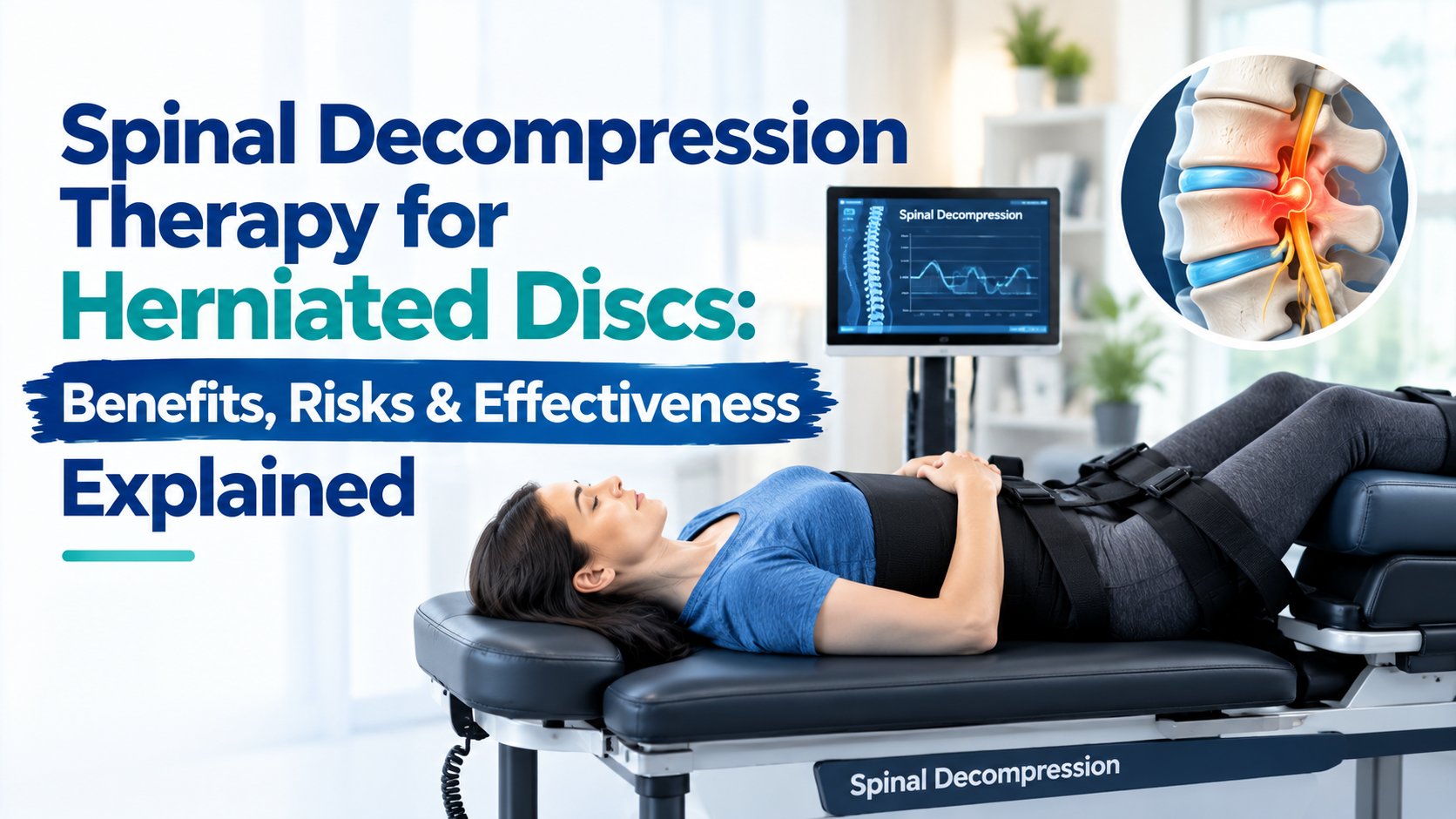
You lie on a computer-controlled table, strapped in at the hips. The machine doesn’t hold one steady pull. It stretches, then eases off, over and over. That cycling is meant to stop your muscles from clenching against the stretch.
he idea is that this creates negative pressure inside the disc, which might draw some of the bulge back toward the middle and help fluid and nutrients move in. Irritated nerves also get a bit more room. Worth remembering: that’s the proposed explanation, and it hasn’t been fully proven.
What Are the Benefits of Spinal Decompression for Herniated Discs?
Patients and clinicians tend to mention the same things:
- No surgery or drugs. No cuts, no anesthesia, no downtime.
- Relief aimed at the nerve. Less pressure can mean less radiating pain, numbness, and tingling.
- Easier daily movement. As pain calms down, walking, bending, and sleeping get more comfortable.
- Possible help for the disc itself. Better nutrient flow is one suggested benefit.
- Comfortable sessions. Most describe a mild stretch. Some find it relaxing.
- Works alongside other care. It combines well with exercise, posture work, and chiropractic adjustments.
Part of the appeal is that it targets a likely cause instead of simply covering up symptoms.
How Effective Is Spinal Decompression Therapy for Herniated Discs?
The evidence is encouraging but unfinished. Several small studies and plenty of patient accounts show real improvements in pain and function, especially for disc-related sciatica. A few imaging studies even found smaller bulges after a full course of treatment.
Still, big, well-designed trials are hard to come by, and results differ widely between people. Outcomes tend to be better when:
- The herniation is mild or moderate
- Treatment starts early
- The patient completes the full plan
- Rehab exercises and lifestyle changes go along with it
A usual course is 15 to 25 visits over several weeks, each lasting 20 to 45 minutes. Progress builds slowly, so showing up consistently matters.
Is Spinal Decompression Therapy Safe?
For people who’ve been screened properly, the risk is low. Side effects are usually mild and short-lived, such as soreness or stiffness afterward, similar to how you feel after a new workout.
Serious problems are rare, but it isn’t for everybody. An exam, and sometimes an MRI or X-ray, helps confirm it’s safe in your case. It’s generally not recommended for:
- Pregnant women
- People with spinal fractures, tumors, or infections
- Those with severe osteoporosis
- Anyone with an abdominal aortic aneurysm
- Patients with spinal implants, fusion hardware, or notable instability
Seek urgent care if you develop sudden leg weakness, lose control of your bladder or bowels, or feel numbness around the groin. Those can point to an emergency.
How Does Spinal Decompression Compare With Other Herniated Disc Treatments?
A quick look at the main options:
- Rest and medication. Anti-inflammatories and a few easy days can settle a flare-up, but they mostly manage symptoms.
- Physical therapy and exercise. Key for long-term strength and stability, and a good match for decompression.
- Herniated disc chiropractic treatment. Adjustments, mobilization, and soft tissue work can improve motion and are often paired with decompression.
- Epidural steroid injections. They can reduce inflammation for a while, but relief may wear off, and repeat injections come with their own concerns.
- Surgery. Procedures like microdiscectomy are usually kept for severe cases, worsening weakness, or pain that doesn’t respond to conservative care. Risks and recovery are greater.
For mild to moderate disc problems, starting with gentler options and holding surgery in reserve makes sense.
When Should You Consider Spinal Decompression for a Herniated Disc?
It may be worth looking into if you:
- Have been diagnosed with a herniated or bulging disc, degenerative disc disease, or sciatica
- Have had pain for weeks without relief from rest or medication
- Want to avoid or delay injections or surgery
- Have no red-flag conditions that rule it out
If you’re in South Jersey and searching for herniated disc treatment in Moorestown NJ, start with a thorough evaluation. A qualified chiropractor for herniated disc in Moorestown can go over your history and imaging, give you an honest answer on whether you’re a candidate, and build a plan around your symptoms. If you specifically want spinal decompression therapy in Moorestown NJ, ask the clinic how they screen patients, what equipment they use, and how they measure progress.
Final Thoughts
Spinal decompression is a gentle, evidence-informed way to ease pressure on a herniated disc without drugs or surgery. The research is still developing and results vary, but many patients report real gains in pain and mobility, especially when they add exercise and better daily habits. An accurate diagnosis and a plan built for you matter most. If disc pain is wearing you down near Moorestown, the team at Bidwell Chiropractic can evaluate your condition and help you decide whether this approach suits you.
FAQ’s
How does spinal decompression work for herniated discs?
The table gently pulls on the spine, lets go, and repeats, all controlled by a computer. That pulling drops the pressure inside the disc. The idea is that the bulging part can settle back a little and the nerve gets more breathing room, which often means less pain. Some people also find it helps blood and nutrients reach the disc.
Is spinal decompression safe for herniated discs?
It’s generally considered safe once you’ve been checked out first. The most common complaint is some soreness afterward, and that usually fades quickly. The point of the exam is to spot anyone who shouldn’t do it.
Who should avoid spinal decompression therapy?
It’s not recommended if you’re pregnant or have a fracture, tumor, infection, severe osteoporosis, an abdominal aortic aneurysm, or metal hardware in your spine. Your provider will go through your health history before starting.
What can I expect during a spinal decompression session?
You stay in your regular clothes and lie on a padded table with a harness fastened around your hips. The machine pulls and releases for roughly 20 to 45 minutes. Most people say it feels like a mild stretch and find it easy to relax. Some clinics finish with heat or electrical stimulation.
When should you consider spinal decompression therapy?
It’s worth asking about if disc trouble is causing back, neck, or leg pain and rest or medication hasn’t done much. It’s also an option if you’d like to avoid surgery. An evaluation will show whether you’re a good candidate.